


This
is the month of August on etourisme.info, and writing offers reruns of
articles that were released in the first half of the year on the blog.
This paper Philippe Fabry was originally broadcast on February 12.
Return travel to multimedia
, I offer a quick summary of the workshop on big data, "Why the big
data and monitoring will change our lives tourists connected?". Today many data is produced. They are extremely rich sources of information.
You said big data?
Big data is not simply analyzing data. And many believe wrongly have implemented an approach based on the potential of big data.
In this regard Dan Ariely, professor of psychology and behavioral
economics at Duke University in North Carolina in the United States has
had a fun formula, close enough to reality: "The big data is like sex
adolescents: everybody talks about it, nobody really knows how to do,
everybody thinks that everybody does, so everyone claims to do. ".
In recent years, especially with the development of social networks and
connected objects (smartphones, geolocation data ...), there is an
exponential growth of data produced.
Eric E. Schmidt of Google said in 2010 that "We now produce as much
information in two days than in the entire history of mankind through
2003."
According to McKinsey, it is expected to grow by 40% of the data
produced in the world from 2011 to 2020 How to manage the increasing
flow of heterogeneous and often unstructured information? It also store these large amounts of data and especially to deal with. Traditional methods of information processing were incapable of managing such volumes.
The rise of computers, storage capacity, and especially the development
of sophisticated algorithms are used to develop new methodologies. First, the purpose of big data is improved especially effective decision making.
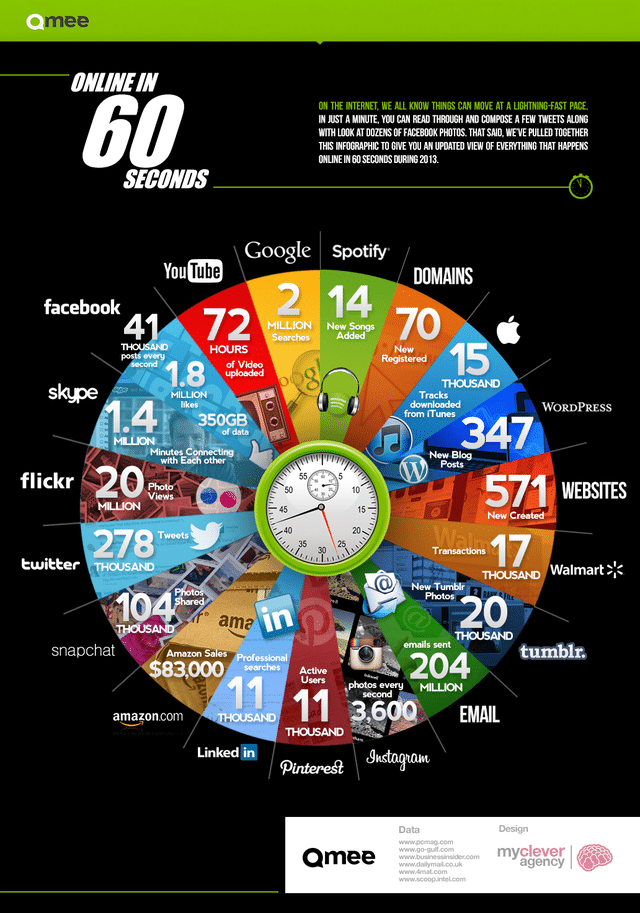
Examples of data produced in 60 seconds ...
The big data, what is it?
Globally, big data is at the heart of discussions of large corporations.
According to IDC, the market is expected to represent the Big 16.9
billion dollars in 2015, with an average annual increase of 40% since
2010 can be summarized big data based on the formula of "4V". Big data is a huge amount of data (volume) published continuously (speed) in structured formats (eg a fee schedule) or not (comments on social networks, for example) from various sources ( variety) and whose legitimacy is not always true (truth). The big data leads ultimately treatment and a detailed analysis of the data. To go further, I suggest you listen Patrice Poiraud, Director, Initiative Big Data Analytics at IBM France.
The big data: value data to create new opportunities
Big data is to make sense of the data. The objectives of big data for marketing are clear. This is primarily to talk fine in data and bring added value to customers. Applications in tourism are manifold.
This can lead to a better understanding of customers, usage and
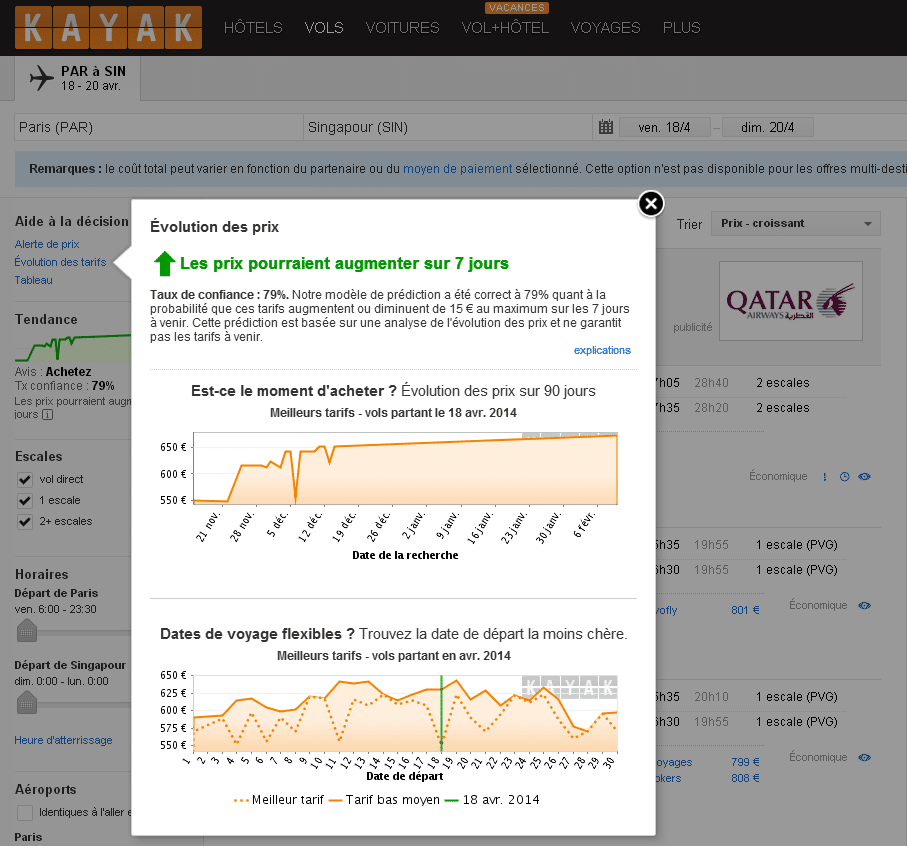
consumption patterns and course improvement or revenue optimization. Consider some examples. Kayaking is not just a price comparison, but also makes predictions about future prices (decision support).
Also exemplary Orange with its big data offering RSS Tourism Vision . Bouches-du-Rhone Tourism has used the tool of observation to better understand the tourists using data collected by the mobile network.
The objective was to develop indicators to segment the different
populations present in the area and better understand the travel ( source ). A similar approach was also undertaken at CRT Riviera Côte d'Azur .
MFG Labs developed for Trump France , a map locating the volume of pictures taken by visitors from Brazil, Russia, India, China (BRIC). We can better understand the presence of foreign tourists on the French territory. Thus, this study allows us to see that the Russians access to the entire French territory.
They are present in Riviera (line Marseille / Moscow), in the Provencal
countryside, to Paris, but also in the Languedoc, Alsace ... The
Brazilians are present on Paris and on the Riviera but we also already
evidence of their presence in other destinations. Finally, the Chinese, like the Brazilians, already travel in other regions, including Provence.
A final example is the "social media monitoring" (listen to social
networks) that allows tourism stakeholders to take advantage of big
data. It allows you to see where consumers are expressed, how they speak territories or products, and what are their interests. This also helps to identify who the influencers online or learn more about the expectations. This can also be to learn about the most discussed or interact in near real time with web topics. For a concrete example, I refer you to the presentation of the study Synthesio on tourist sites of interest seen by social networks .
In conclusion, the field of possibilities for big data in tourism are numerous. Big data professionals already imagining multiple applications.
It will be more and more to aggregate both customer data, geographic or
behavioral and social transactional information to develop a "smart
marketing": that is to say, to target a specific offer according to the
profile of voyageuret of past purchases. It is not yet won when we see the complexity of the customer journey and decision cycle in tourism! In summary, big data is simultaneously listen, observe, analyze, act and anticipate / predict.
Thread Moved from :
http://www.etourisme.info/le-big-data-au-service-des-professionnels-du-tourisme/


0 التعليقات:
إرسال تعليق